Albania
 Argentina
 Australia
 Austria
 Belgium
 Bosnia and Herzegovina
 Brazil
 Bulgaria
 Canada
 Chile
 Colombia
 Croatia
 Czech Republic
 Denmark
 Estonia
 Finland
 France
 Germany
 Greece
 Hungary
 Ireland
 Italy
 Latvia
 Lithuania
 Luxembourg
 Mexico
 Moldova
 Montenegro
 Netherlands
 New Zealand
 North Macedonia
 Norway
 Philippines
 Poland
 Portugal
 Romania
 Serbia
 Slovakia
 Slovenia
 South Africa
 Spain
 Sweden
 Switzerland
 Turkey
 Ukraine
 United Kingdom
 United States of America



Passive Subwoofers
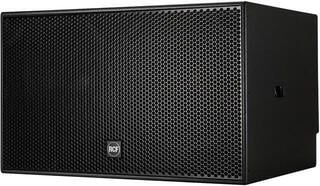
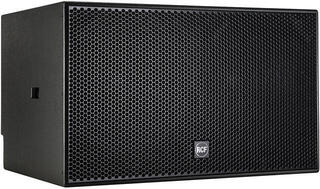
A passive subwoofer does not have a built-in power amplifier, so you connect it to an external amplifier and, depending on the setup, also to a crossover or processor. It adds low frequencies in concert sound reinforcement, clubs, rehearsal rooms, or permanent installations. When choosing, consider impedance, power handling, sensitivity, driver diameter, connectors, and dimensions. Do not choose a subwoofer in isolation: it must match the amplifier, main speaker cabinets, and wiring method.
The amplifier and impedance must form one system
Check how much power the amplifier delivers at the impedance of the connected load, and compare specifications defined in the same way. When several cabinets are connected in parallel, the resulting impedance decreases; in series it behaves differently, but this is used in professional sound reinforcement according to the specific design and manufacturer’s recommendation. Do not go below the amplifier’s minimum load. An incorrect combination may trigger protection, cause overheating, or result in damage.
The number of watts alone does not tell you how loudly and deeply the system will play. The result is affected by driver sensitivity, enclosure design, signal processing, and room acoustics. Compare power ratings under matching conditions and distinguish between continuous and peak values. A suitable power amplifier must also have the right connectors, cooling, and protection for the intended operation.
Comparison of common driver diameters
| Driver diameter | Typical use | What to expect |
|---|---|---|
| 12 inches | Smaller sound systems, clubs, and mobile setups | More compact enclosure, generally less emphasis on the lowest range than with larger models |
| 15 inches | Concerts, clubs, and setups that are frequently transported | Balance between size, weight, and bass extension |
| 18 inches | Deeper bass and more powerful sound reinforcement systems | Larger dimensions, weight, and more demanding handling |
Diameter is only the first reference specification. Two subwoofers with equally sized drivers may differ in frequency response, sensitivity, and maximum level. Check the complete manufacturer specifications and compare them with the main system. For a mobile band, a lighter cabinet that you can carry safely may be more practical than a larger model without suitable transport.
Frequency splitting and signal processing
A subwoofer should not reproduce the entire frequency range intended for the main speaker cabinets. An active crossover or loudspeaker processor splits the signal and can provide filters, delay, and protective limiting. Set the crossover frequency and slope according to the recommendations for the specific cabinets; there is no universal value suitable for every combination. Incorrect overlap may create an excess or dip around the crossover band.
Crossovers and speaker systems are used to manage the setup. If you use processing built into the amplifier, check which outputs and filters are active. The signal path should also be clear to another technician: label inputs, outputs, and stored settings, and protect them from unintended changes.
Connections, connectors, and cables
Between the power amplifier and passive subwoofer, use a speaker cable with an appropriate conductor cross-section, not a microphone or standard instrument cable. Check the connector type and contact wiring, especially with multi-core systems. A long or thin cable increases losses. A damaged connector may cut out under high load, so inspect and label cables regularly.
- Switch on the amplifier after the signal sources and switch it off first.
- Switch off the system before reconnecting the power section.
- Do not connect the outputs of two amplifiers to one cabinet without a designated system.
- Maintain polarity wiring in all cables and cabinets.
- Keep the amplifier ventilation openings clear.
Passive or active subwoofer
A passive solution gives you the freedom to choose the amplifier, processing, and placement of the power section in a shared rack. An advantage may be a simpler enclosure without mains power input, but you must match more components and run a speaker cable to the cabinet. An active subwoofer has an amplifier built in and often includes basic signal processing, so wiring a smaller setup is usually more straightforward.
If you are only adding to an existing system, first verify compatibility with its main cabinets and processor. You can find an overview of both concepts in the subwoofers category. Do not mix different models without checking polarity, phase, sensitivity, and delay; more cabinets do not automatically mean a more even result.
Placement in the room
Low frequencies are strongly affected by the room and the relative position of the cabinets. Placement near a wall or in a corner may change the bass level, but also emphasize certain resonances. Two subwoofers placed apart may add together in some locations and cancel in others. Start with the recommended arrangement, listen in several locations, and use measurement and time alignment for a larger setup.
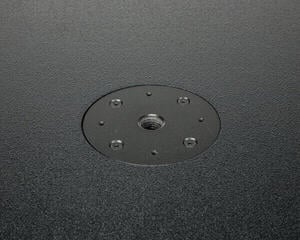
Do not place the subwoofer where it blocks an escape route or could tip over. When mounting a main cabinet on a pole, observe the permitted load and use compatible telescopic speaker poles. Never improvise with an unstable extension. Carry a heavy cabinet in pairs or using suitable equipment, and protect the connectors during transport.
Check before starting the setup
- Write down the impedance and power ratings of each cabinet.
- Calculate the load on each amplifier channel according to the wiring.
- Set the crossover, protective filters, and limiter according to the documentation.
- Verify cable polarity and signal routing at a low level.
- Increase the volume gradually and monitor the amplifier indicators and the sound of the drivers.
For the final check, return to the entire setup, not only to the driver diameter or power rating. If the impedance, amplifier, crossover filters, and mechanical mounting match, the system is easier to set up and safer to transport. If you are unsure about electrical or signal wiring, follow the manufacturer’s documentation and consult the design with an experienced sound technician.